
Australia Subclass 485 Visa Family Rules Change from 13 November 2026: What International Graduates Need to Know
- November 12, 2026
- Posted by: Sandeep
- Category: Study Abroad
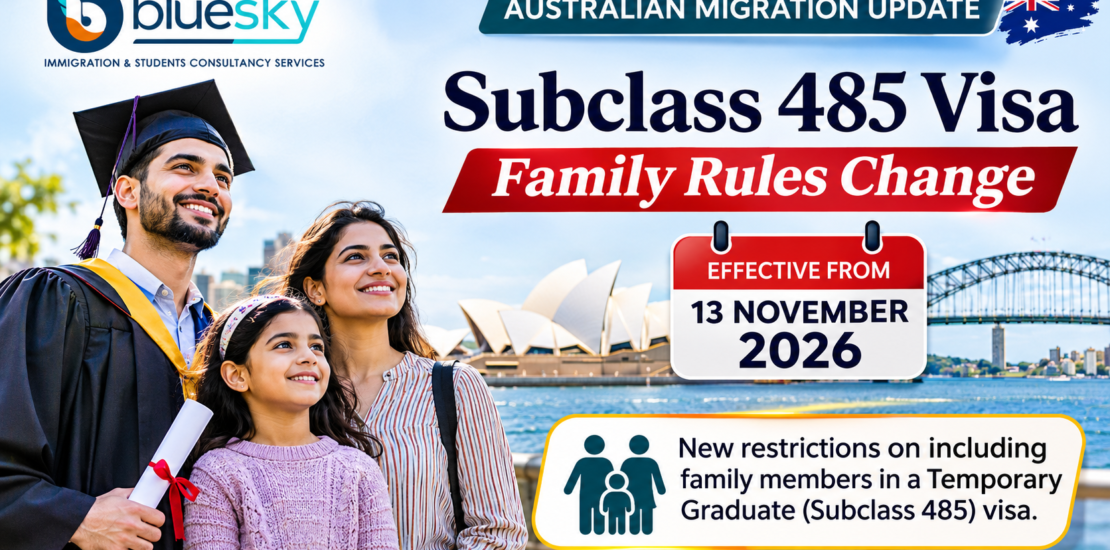
Australia has introduced significant changes to the family inclusion rules for the Temporary Graduate visa (Subclass 485), affecting international students who plan to remain in Australia after completing their studies.
The Migration Amendment (Temporary Graduate Visa Reform) Regulations 2026 was registered on 12 November 2026 and will take effect from 13 November 2026.
Under the new regulations, the ability to include family members in a Subclass 485 visa application will be significantly restricted. The changes are particularly important for international graduates who completed a Bachelor’s or Master’s degree in Australia and are planning to bring their spouse, partner or dependent children to Australia.
For many graduates, the new rules may change how they plan their post-study stay, family arrangements and visa applications.
In this guide, Bluesky Immigration explains the new Subclass 485 family rules, who may be eligible to include family members, the exceptions available under the regulations and what graduates should consider before submitting their applications.
What Is the Australia Subclass 485 Temporary Graduate Visa?
The Temporary Graduate visa (Subclass 485) allows eligible international students who have recently completed an eligible qualification in Australia to stay temporarily in the country.
It provides graduates with an opportunity to gain practical Australian work experience, develop professional skills and explore career opportunities after completing their studies.
The visa has different streams, including:
- Post-Higher Education Work stream
- Post-Vocational Education Work stream
- Second Post-Higher Education Work stream
Applicants must meet the relevant eligibility requirements for their chosen stream, including qualification, age, English language and other applicable visa criteria.
However, from 13 November 2026, applicants must also pay close attention to the new family inclusion requirements.
What Are the Major Changes to Subclass 485 Visa Family Rules?
The most significant change is that eligible family members must generally apply together with the primary Subclass 485 visa applicant.
Previously, certain family members could apply separately through a subsequent entrant application after the primary applicant had already received their Temporary Graduate visa.
This separate subsequent entrant pathway is being removed under the new regulations.
The new rules also introduce specific eligibility requirements for family members who wish to apply as secondary applicants.
This means that having a spouse or partner does not automatically make them eligible to join the primary applicant through the Subclass 485 visa pathway.
Who Can Include Family Members Under the New 485 Visa Rules?
Under the new regulations, family members may generally be included only where specific exceptions apply.
The following categories are covered by the new provisions.
1. Pacific and ASEAN Nationals
Primary applicants who hold passports from eligible Pacific-region countries or ASEAN member countries are exempt from the usual requirement that their family members must have previously held a Student or Temporary Graduate visa as secondary applicants.
Their eligible family members may apply together with the primary applicant, subject to the other applicable requirements.
2. PhD Graduates
Graduates who completed a doctoral degree on their most recent Student visa are included in the exempt category.
This exemption recognises the contribution of doctoral graduates to Australia’s research, innovation and skilled workforce.
Eligible family members may apply with the primary applicant without having to satisfy the usual previous Student or Temporary Graduate visa requirement.
3. Students Funded by Foreign Government Scholarships
International graduates whose studies were fully funded by a foreign government scholarship on their most recent Student visa are also included in the exempt category.
Their eligible family members may apply together with the primary applicant under the relevant provisions.
4. Children Born After the Relevant Student or 485 Visa Grant
The regulations provide an exception for a child born after the primary applicant was granted their most recent Student visa or Temporary Graduate visa.
This provision allows eligible children to be included in the primary applicant’s new Subclass 485 application.
5. Certain Family Members Who Previously Held a Student Visa
Some family members who previously held a Student visa as secondary applicants may still qualify.
This applies where the family member:
- Held a Student visa on 2 October 2026; or
- Held a Student visa at some point during the six months immediately before the new Subclass 485 application.
The previous Student visa must have been granted on the basis that the family member was a secondary applicant for the same primary applicant.
6. Certain Family Members Who Previously Held a Subclass 485 Visa
Family members who previously held a Temporary Graduate visa as secondary applicants may also qualify under the transitional provisions.
Generally, they must hold or have held a Subclass 485 visa within the six months immediately before the new application, with the same primary applicant.
Important: These exceptions have specific legal requirements. Meeting a broad category alone does not guarantee visa eligibility.
Can You Bring Your Spouse to Australia After Receiving a 485 Visa?
This is one of the most important questions for international graduates.
Under the new regulations, the ability to add a spouse or partner through a separate Subclass 485 subsequent entrant application will no longer be available.
For example:
Imagine an international student completes a Master’s degree in Australia and applies for a Subclass 485 visa without including their spouse.
After receiving the 485 visa, the graduate decides that their spouse should join them in Australia.
Under the new rules, the spouse will generally not be able to apply separately as a subsequent entrant for that existing 485 visa.
The position may be different if the spouse meets one of the specific exceptions under the regulations.
Family members who do not qualify under the new Subclass 485 provisions may still explore other visa options, subject to meeting the requirements of the relevant visa subclass.
Do Spouses and Children Need to Apply Together With the Primary Applicant?
Yes. The new regulations require primary and eligible secondary applicants to submit their Subclass 485 applications together.
This means:
- The primary applicant and eligible family members must make a combined application.
- Family members cannot simply be added to an already granted Subclass 485 visa through the previous subsequent entrant pathway.
- The primary applicant must be in Australia when applying.
- Eligible secondary applicants may apply from inside or outside Australia, subject to applicable requirements.
For family members applying from within Australia, additional requirements regarding their current visa status may apply.
For example, they may need to hold a substantive visa, a Bridging A visa or a Bridging B visa, or satisfy another specifically prescribed circumstance.
How Will the New Rules Affect Bachelor’s and Master’s Graduates?
The changes are particularly important for international students completing undergraduate and postgraduate qualifications in Australia.
Consider the following situations:
Scenario 1: Student Already Has a Spouse in Australia
A student completes a Master’s degree and has a spouse who was previously included as a secondary applicant on their Student visa.
If the spouse meets the previous visa-holding requirements, they may be able to apply together with the primary applicant for the Subclass 485 visa.
Scenario 2: Student Gets Married Before Applying for the 485 Visa
A graduate gets married before submitting their Temporary Graduate visa application.
If the spouse was not previously included in the relevant Student or Temporary Graduate visa arrangements, the spouse may not qualify under the standard provisions.
The graduate should check whether an exemption applies before lodging the application.
Scenario 3: Student Gets Married After Receiving the 485 Visa
A graduate receives their Subclass 485 visa and subsequently gets married.
Under the new rules, their new spouse will generally not be able to join them through a separate Subclass 485 subsequent entrant application.
The couple may need to investigate alternative visa pathways.
Scenario 4: PhD Graduate Applying With a Spouse
A graduate completes a doctoral qualification on their most recent Student visa.
The PhD exemption may allow their eligible spouse or other family members to apply together with them without satisfying the usual previous Student or 485 visa requirement.
Each scenario must be assessed against the actual legislative requirements.
What Should International Students Do Before Applying for a Subclass 485 Visa?
The new regulations make advance visa planning especially important for international graduates.
If you are currently studying in Australia or preparing to apply for a Temporary Graduate visa, consider the following steps:
- Review your family arrangements: Confirm whether your spouse or dependent children were included in your previous Student visa application.
- Check your visa history: Identify whether your family members currently hold or previously held a Student or Temporary Graduate visa as secondary applicants.
- Consider your application timing: Understand which regulations apply to your proposed application and avoid making decisions based on assumptions about transitional arrangements.
- Check available exemptions: Determine whether the primary applicant falls within the Pacific, ASEAN, doctoral graduate or foreign government scholarship categories.
- Prepare your documents: Organise marriage certificates, birth certificates, previous visa grants and other supporting evidence relevant to your circumstances.
- Seek professional migration advice: Have your individual circumstances assessed before lodging the application.
Frequently Asked Questions About the New Subclass 485 Visa Family Rules
1. When will the new Australia 485 visa family rules start?
The new regulations commence on 13 November 2026. They were registered on the Federal Register of Legislation on 12 November 2026.
2. Can I include my wife or husband in my 485 visa application?
You may be able to include your spouse if they satisfy the new secondary applicant requirements or an applicable exemption. Marriage alone does not establish eligibility.
3. Can my spouse apply for a 485 visa after I receive my visa?
Generally, no. The new rules remove the separate subsequent entrant application pathway for family members wishing to join an existing Subclass 485 visa holder.
4. Are PhD graduates exempt from the new family inclusion restrictions?
Primary applicants who completed a doctoral degree on their most recent Student visa are included in an exemption. Their eligible family members may apply without meeting the usual previous Student or 485 visa requirement.
5. Can I include my newborn baby in my 485 visa application?
The regulations provide an exception for a child born after the primary applicant received their most recent Student or Temporary Graduate visa. Specific circumstances and supporting evidence must be assessed.
6. What happens if my spouse was not included in my Student visa?
Your spouse may not qualify under the standard family inclusion provisions. However, the specific exemptions and other available visa options should be assessed before making a decision.
7. Can family members apply from outside Australia?
Yes. Eligible secondary applicants can apply from inside or outside Australia, provided the application is made together with the primary applicant and all relevant requirements are met.
8. Will these changes affect every Subclass 485 applicant?
The new requirements affect applications involving secondary applicants. Graduates applying without family members should still meet all other applicable Subclass 485 visa requirements.
Get Professional Guidance for Your Australia 485 Visa Application
Australia’s new Subclass 485 visa family rules introduce important considerations for international students and recent graduates.
For Bachelor’s and Master’s graduates, in particular, understanding the family inclusion requirements before lodging an application can help avoid unnecessary complications and incorrect assumptions about bringing a spouse or dependent children to Australia.
At Bluesky Immigration & Students Consultancy Services, we assist international students and graduates with Australian migration and visa-related guidance.
Our team can help you understand the relevant requirements, review your family circumstances and explore appropriate visa options based on your individual situation.
Speak with our Registered Migration Agent:
Shayaz Khan
Registered Migration Agent
MARN: 0639214
Phone: 02 9212 0922
Mobile: 0425 536 600
Website: https://blueskyconsultancy.com/
Planning to apply for an Australian Temporary Graduate visa? Get your family inclusion eligibility assessed before lodging your application.
Disclaimer: This article provides general information about the Migration Amendment (Temporary Graduate Visa Reform) Regulations 2026. It is not legal or migration advice. Visa eligibility depends on individual circumstances and the applicable legislation. Always obtain professional advice before making an immigration decision.
Disclaimer:
The information contained on this blog post is for informational purposes only and is not intended to be a substitute for professional advice. And the information provided on this blog should not be construed as professional advice.
While I strive to provide accurate and up-to-date information, I cannot guarantee that all information is complete or error-free. You should always consult with a qualified professional before making any decisions based on the information contained on this blog post.