
Complete Guide to Australia’s MD 115: What the New Student Visa Rules Mean for You (2026 Intake)
- March 16, 2026
- Posted by: Sandeep
- Category: Study Abroad
If you are an international student planning to study in Australia, you have likely heard the buzz around MD 115. Understandably, any change to visa rules can feel stressful, especially when your future education is on the line.
Take a deep breath: MD 115 is not a visa ban. It is simply a new system that changes how fast your visa is processed based on the university or college you choose.
Effective from November 14, 2025, Australia’s Ministerial Direction 115 (MD 115) has replaced the old MD 111 rules. Let’s break down exactly what this means, how the new “traffic light” processing system works, and how you can use this knowledge to get your Subclass 500 student visa approved as smoothly as possible for the 2026 intake.
What is Ministerial Direction 115 (MD 115)?
Ministerial Direction 115 is a new directive from the Australian Government that dictates how offshore Student Visa (Subclass 500) applications are prioritized.
Previously, visa processing was largely a first-come, first-served queue. Under MD 115, the Department of Home Affairs now links your visa processing speed directly to your chosen education provider’s National Overseas Student Capacity (NOSC).
Simply put: If your chosen university manages its international student enrollment quotas responsibly, your visa will be processed faster. If the university has over-enrolled, your visa will sit in the slow lane.
How the MD 115 “Traffic Light” Visa Processing System Works
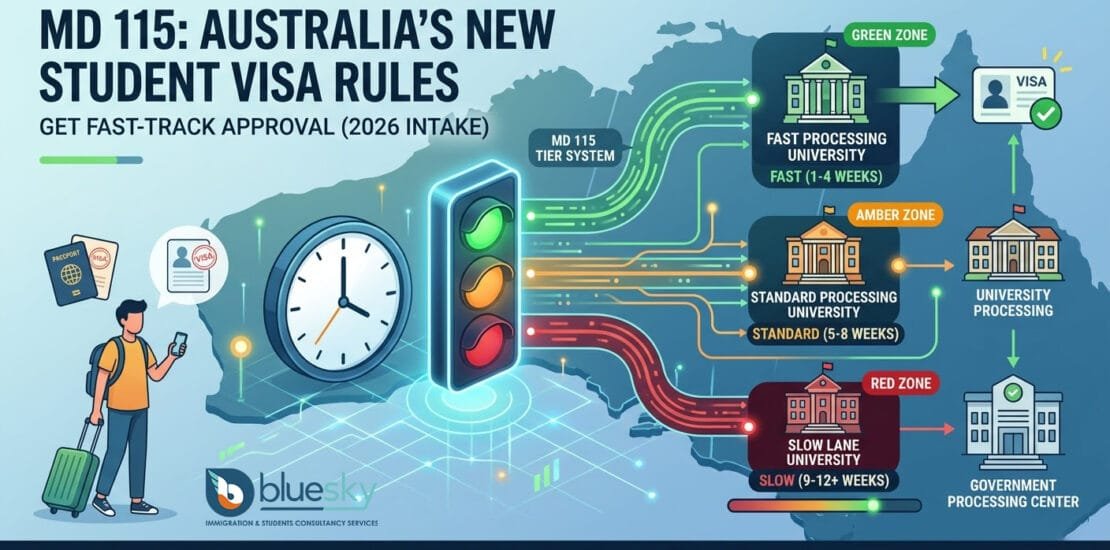
MD 115 sorts all offshore student visa applications into a three-tier system. Think of it as a traffic light where the “color” depends on how many international students your university has enrolled compared to its government-allocated limit.
| Priority Tier | Provider Capacity Status | Processing Speed | What It Means for You |
| Priority 1 (Green Zone) | Below 80% of allocation limit | Fast-Track (1–4 weeks) | Highest priority. Applications linked to these institutions jump to the front of the queue. |
| Priority 2 (Amber Zone) | 80% to 115% of allocation limit | Standard (5–8 weeks) | Normal processing times. The institution is near its cap, so expect moderate wait times. |
| Priority 3 (Red Zone) | Exceeds 115% of allocation limit | Slow Lane (9–12+ weeks) | Lowest priority. If your chosen university is over-enrolled, your visa will face significant delays. |
Note: Priority 1 also automatically includes certain categories, such as school students, fully funded government scholarship students, and PhD/Postgraduate research students.
Why Did Australia Introduce MD 115?
Australia introduced this rule after experiencing overwhelming surges in international student arrivals, which put massive pressure on local housing markets and infrastructure. The government’s goals with MD 115 are to:
- Promote fair distribution: Push students away from overcrowded metropolitan universities and toward excellent, under-utilized regional institutions.
- Reward good behavior: Give fast-track privileges to universities that strictly follow their enrollment quotas.
- Enhance system integrity: Ensure only high-quality providers and genuine students benefit from the Australian education system
What MD 115 Means for International Students
If you are an international student (particularly from high-volume applicant countries like India), MD 115 completely changes your application strategy.
- Your Choice of University is Now Critical: Academic reputation isn’t the only factor anymore. You must now consider the institution’s regulatory standing. Applying to a heavily oversubscribed “famous” university in Sydney or Melbourne might mean waiting months for a visa.
- Regional Universities Have a Massive Advantage: Providers outside major city centers are far less likely to have hit their enrollment caps. Applying to regional universities or mid-sized colleges puts you firmly in the “Green Zone” for fast-tracked visas.
- Higher Scrutiny: Because the government is prioritizing system integrity, your Genuine Student (GS) statement and financial documents will be scrutinized more closely than ever.
5 Actionable Tips to Secure Your Visa Faster Under MD 115
- Ask About the Quota: Before accepting an offer, directly ask your education agent or the university admissions office where they currently stand regarding their NOSC allocation limit. Aim for institutions under 80%.
- Apply Early for 2026: Do not wait until the last minute. Because of the new tiered system, processing times are unpredictable for Priority 2 and 3 applicants. Submit your application as early as possible.
- Nail Your Genuine Student (GS) Statement: Ensure your statement clearly outlines why you want to study your specific course in Australia and how it ties to your future career goals in your home country.
- Prepare Flawless Financials: Ensure your proof of funds is authentic, accessible, and clearly documented. Gaps or inconsistencies will lead to instant delays or rejections.
- Consider Regional Campuses: Look into universities in areas like Adelaide, Perth, Hobart, or regional NSW/Victoria. Not only do they offer a great lifestyle and potential migration advantages, but they are also highly likely to fall under Priority 1.
Other Crucial Australia Student Visa Changes to Keep in Mind
MD 115 isn’t the only recent change. Make sure you budget and plan for the following:
- Increased Visa Fees: As of recent updates, the Subclass 500 visa application fee has jumped significantly to AUD 1,600.
- Stricter Onshore Rules: “Visa hopping” is being clamped down on. It is now much harder to arrive in Australia on a Visitor Visa and switch to a Student Visa onshore.
- Tougher English Requirements: Minimum required scores for IELTS/PTE have been slightly raised to ensure students can handle the academic workload.
Frequently Asked Questions (FAQs)
No. MD 115 does not limit the number of visas granted or ban anyone from applying. It is purely a sorting mechanism that dictates the speed at which your application is processed based on your university’s enrollment numbers.
No. MD 115 only applies to offshore applicants—meaning students applying for their visa from outside of Australia.
Not necessarily. If a top-tier university has exceeded 115% of its international student quota, your application will still drop to Priority 3 (Slow Lane). Always check the institution’s capacity status.
Yes! Your work rights remain unchanged: you can work up to 48 hours per fortnight during the semester and unlimited hours during official study breaks.
Disclaimer:
The information contained on this blog post is for informational purposes only and is not intended to be a substitute for professional advice. And the information provided on this blog should not be construed as professional advice.
While I strive to provide accurate and up-to-date information, I cannot guarantee that all information is complete or error-free. You should always consult with a qualified professional before making any decisions based on the information contained on this blog post.
