The Ultimate Guide to Study Abroad in 2026: Top Destinations, Costs, and Visa Tips
- February 20, 2026
- Posted by: Sandeep
- Category: Study Abroad
Thinking about taking your education to the global stage? You aren’t alone. In 2026, the study abroad landscape is more dynamic than ever. From the tech-hubs of Seoul to the zero-tuition universities of Germany, international education is no longer just a luxury—it’s a strategic career move.
This guide breaks down everything you need to know to navigate the “Study Abroad” journey, from picking a destination to securing a fully-funded scholarship.
Why Study Abroad in 2026?
The global job market now prioritizes “cultural intelligence” and international exposure. According to recent 2026 employment data, over 60% of global employers prefer candidates with international experience.
- Global Networking: Build a professional circle that spans continents.
- Specialized Courses: Access niche programs like Renewable Energy Tech in Germany or AI Ethics in the UK.
- Higher ROI: Graduates from top-tier global universities often see a 30-50% increase in starting salaries compared to local graduates.
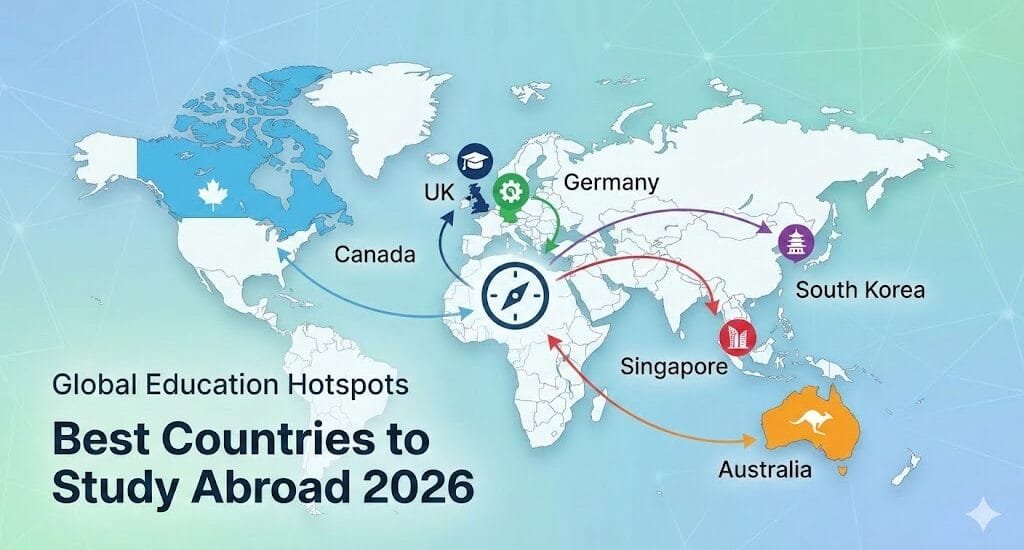
Top 5 Study Abroad Destinations for 2026
Choosing the right country is 50% of the battle. Here is how the top contenders stack up this year:
1. United Kingdom: The King of Efficiency
With its 1-year Master’s programs and a transparent Points-Based Visa System, the UK remains a top choice. The “Graduate Route” still allows students to stay for 2 years post-graduation.
- Best for: Business, Law, and Creative Arts.
2. Germany: High Quality, Low Cost
Germany is the go-to for “debt-free” education. Most public universities offer near-zero tuition. You only need to prove financial stability through a Blocked Account (approx. €11,904 for 2026).
- Best for: Engineering, Robotics, and Research.
3. Canada: The Multicultural Hub
Despite stricter visa caps in early 2026, Canada remains highly attractive due to its Post-Graduation Work Permit (PGWP) and clear pathways to Permanent Residency (PR).
- Best for: IT, Healthcare, and Environmental Science.
4. Australia: Quality of Life
Australia has introduced the Genuine Student (GS) Test in 2026 to ensure high-quality applicants. It offers a perfect balance of world-class research and an outdoor lifestyle.
- Best for: Medicine, Nursing, and Marine Biology.
5. South Korea & Singapore: The Rising Giants
For those looking at the “Asian Century,” South Korea (Tech/K-Culture) and Singapore (Finance/Global Hub) offer some of the highest-ranked universities in the world, like NUS and NTU.
Step-by-Step Checklist to Study Abroad
Success requires a 12-to-18-month lead time. Follow this roadmap:
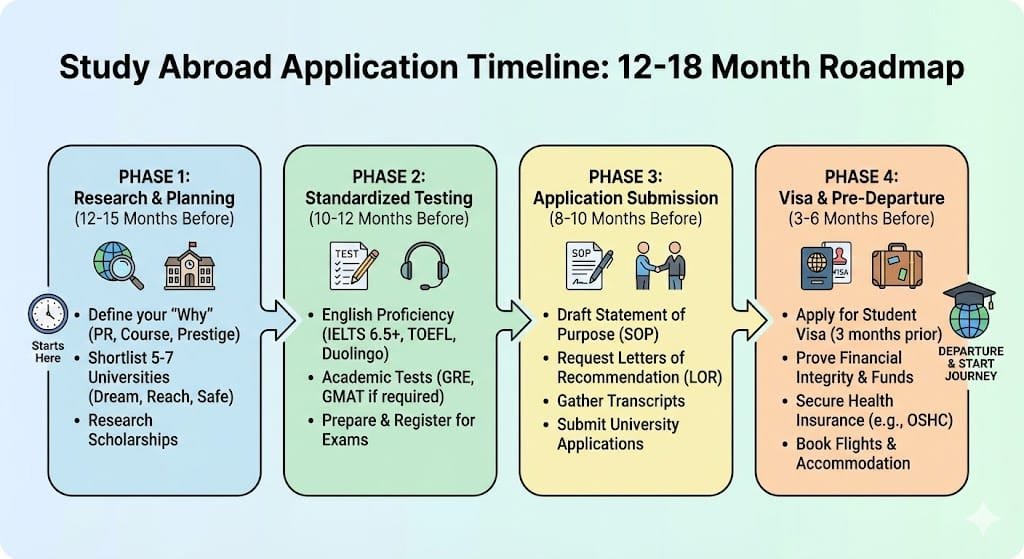
First Phase: Research & Planning (12–15 Months Before)
- Identify your “Why”: Is it for PR, a specific course, or university prestige?
- Shortlist 5-7 Universities: Mix your choices between “Dream,” “Reach,” and “Safe” schools.
2 nd Phase: Standardized Testing (10–12 Months Before)
- English Proficiency: Take the IELTS (target 6.5+), TOEFL, or Duolingo English Test.
- Academic Tests: Some US/EU programs may still require GRE or GMAT.
Phase 3: The Application (8–10 Months Before)
- Statement of Purpose (SOP): Don’t just list achievements; tell a story of growth.
- Letters of Recommendation (LOR): Get these from mentors who know your character, not just your grades.
Costs and Financial Aid (2026 Estimates)
How much does it cost to study abroad?” is the most asked question. Here’s a quick comparison:
| Country | Avg. Annual Tuition (USD) | Monthly Living Cost | Work Rights (Hours/Week) |
| USA | $25,000 – $55,000 | $1,200 – $2,000 | 20 (On-campus) |
| UK | $15,000 – $35,000 | $1,100 – $1,600 | 20 |
| Germany | $0 – $3,500 | $900 – $1,100 | 20 |
| Australia | $20,000 – $40,000 | $1,400 – $1,900 | 24 |
| Canada | $15,000 – $30,000 | $1,000 – $1,500 | 20 |
Top Scholarships for 2026
Finding the right financial aid can make your study abroad dream a reality. Here are the most prestigious scholarships available for the 2026 intake:
- Australia Awards (Australia): Funded by the Australian Government, these are fully funded scholarships for students from developing countries. They cover 100% of tuition, airfare, a living stipend, and health insurance (OSHC). Applications for 2027 intake open February 1, 2026.+2
- Destination Australia (Australia): Designed to encourage international students to study in regional areas, this award provides up to $15,000 per year to help with tuition and living costs.
- Research Training Program (RTP – Australia): A must-apply for research students. It covers tuition fees and provides a living stipend of approximately $37,000 – $52,000 per year for Master’s and PhD candidates.
- Chevening (UK): A global program that offers full financial support for a one-year Master’s degree at any leading UK university.
- Fulbright (USA): One of the most famous exchange programs, offering full funding for graduate study and research in the United States.
- DAAD Scholarships (Germany): Specifically for postgraduate students and researchers looking to study at Germany’s top-tier public institutions.
- Erasmus Mundus (Europe): A unique opportunity to study in at least two different European countries with all costs covered.
Visa Requirements: What’s New in 2026?
Visa policies have shifted toward “Proof of Funds” and “Intent.”
- Financial Integrity: Most countries now require bank statements to be at least 28–90 days old to prove the funds aren’t “borrowed.”
- Digital Visas: Countries like Finland and the UK have moved almost entirely to digital E-Visas, speeding up processing times to under 30 days.
- Health Insurance: Mandatory in almost every destination (e.g., OSHC in Australia).
Pro Tip: Always apply for your visa at least 3 months before your intake starts. 2026 has seen a surge in applications, leading to “peak season” delays.
Studying abroad is an investment in your future self. While the paperwork might seem daunting, the perspective you gain is priceless. Whether you’re chasing an Ivy League dream or a tuition-free European degree, the key is to start early and stay organized.
Would you like me to help you draft a personalized Statement of Purpose (SOP) or find a specific scholarship for your chosen field?
Disclaimer:
The information contained on this blog post is for informational purposes only and is not intended to be a substitute for professional advice. And the information provided on this blog should not be construed as professional advice.
While I strive to provide accurate and up-to-date information, I cannot guarantee that all information is complete or error-free. You should always consult with a qualified professional before making any decisions based on the information contained on this blog post.
