
NEET UG 2026 MBBS Counselling: Complete Guide to All India, State, Private & Deemed University Admissions
- July 22, 2026
- Posted by: Sandeep
- Category: Study Abroad
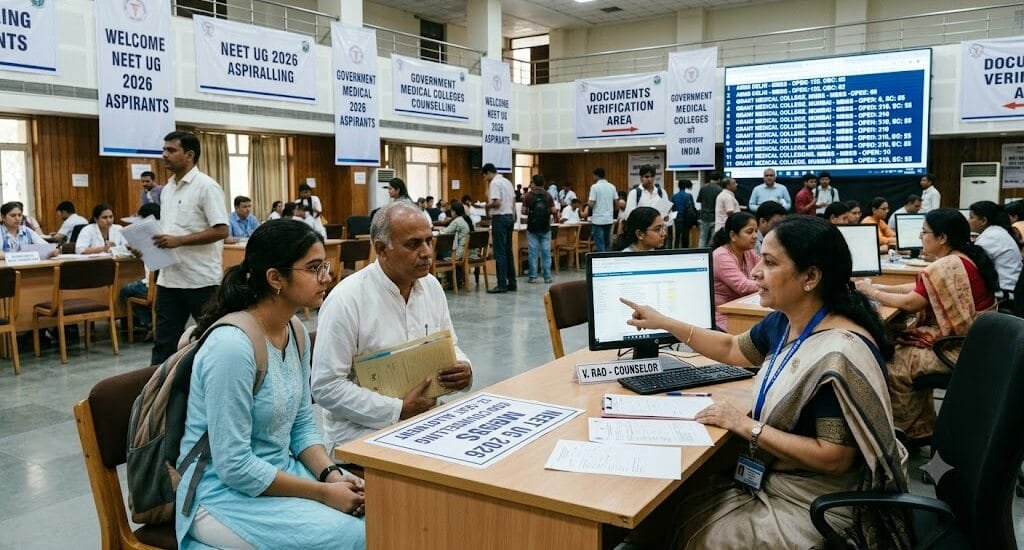
Qualifying for NEET UG 2026 is an important achievement, but securing an MBBS seat requires the next crucial step: NEET UG counselling.
Many students and parents become confused about the different counselling authorities, quotas, rounds, eligibility criteria, fees, choice filling, seat allotment, and college selection. A good NEET score does not automatically guarantee admission to a preferred medical college. Your final admission depends on several factors, including:
- NEET UG 2026 All India Rank (AIR)
- Category and reservation status
- State domicileCounselling quota
- College preference
- Tuition fee and total cost
- Previous-year closing ranks
- Seat availability
- Eligibility conditions
This complete guide explains the NEET UG 2026 MBBS counselling process in India, including MCC counselling, state counselling, government colleges, private colleges, deemed universities, central universities, ESIC institutions, minority institutions, and other admission routes.
Important: NEET UG 2026 counselling schedules, seat matrices, fees, and closing ranks may change. Students should always verify the latest official notifications before making a final decision. NEET is the common entrance examination for undergraduate medical education in India, and MCC conducts counselling for several major national-level quotas and institutions.
What Is NEET UG 2026 Counselling?
NEET UG counselling is the online admission process through which eligible NEET-qualified candidates compete for MBBS and BDS seats.
During counselling, students:
- Register online
- Pay the required counselling fee and security deposit
- Fill in their preferred colleges and courses
- Lock their choices
- Receive seat allotment based on rank, category, choices and seat availability
- Report to the allotted college
- Complete document verification and admission formalities
The counselling process is generally conducted through two major channels:
1. MCC Counselling
The Medical Counselling Committee (MCC) conducts counselling for various national-level quotas and institutions, including major All India Quota seats and certain central and other participating institutions. MCC’s official framework includes online counselling for 15% All India Quota undergraduate seats, along with specified institutional and central-institution categories.
2. State Counselling
State counselling authorities conduct admission for seats under their respective state quotas and other participating categories.
The exact eligibility rules, domicile requirements, reservation policies, fees, and participating colleges vary from state to state.
Main Types of MBBS Counselling in India
1. MCC All India Quota Counselling
MCC counselling is one of the most important counselling processes for NEET UG candidates.
Seats commonly associated with MCC counselling include:
- 15% All India Quota seats of participating government medical colleges
- Central universities and institutions
- Certain institutional quota seats
- Deemed universities
- ESIC-related categories, where applicable
- Armed Forces Medical College-related counselling processes, subject to applicable rules
- Other categories and institutions notified by MCC
Candidates from different states can compete for many All India Quota seats, subject to the applicable eligibility rules.
Who should participate?
Students should generally consider MCC counselling if they:
- Want to compete for MBBS seats outside their home state
- Have a strong NEET rank
- Want to explore central institutions
- Are eligible for deemed university seats
- Want to compare government and private medical college options across India
2. State Quota Counselling
State counselling is extremely important because it may provide access to a larger number of MBBS seats in government and private medical colleges.
In many states, approximately 85% of eligible government medical college seats are associated with the state quota framework, although the exact structure and exceptions can vary according to applicable rules and institutional arrangements.
State counselling may include:
- Government medical colleges
- State government quota seats in private colleges
- Private medical colleges
- Minority institutions
- NRI seats, where applicable
- Management quota seats
- Other state-specific categories
Why domicile matters
A student may have a significant advantage in their domicile state because state counselling can include:
- State reservation benefits
- Domicile-based eligibility
- State-specific category benefits
- Access to state quota seats
For example, a student with a particular state domicile may have substantially different admission opportunities in their home state compared with the same NEET rank in another state.
Never compare your rank with a closing rank without checking the counselling quota and domicile requirements.
3. Government MBBS College Counselling
Government medical colleges are generally the first preference for students because of their relatively lower tuition fees.
However, admission is highly competitive.
Advantages of government medical colleges
- Lower tuition fees in many institutions
- Strong patient exposure
- Large government hospitals attached to many colleges
- High clinical case volume
- Lower overall academic cost compared with many private institutions
What determines admission?
Your chances depend on:
- NEET AIR
- Category
- State domicile
- Counselling quota
- Choice filling
- Seat availability
- Previous-year closing trends
A candidate with a lower rank may secure a government MBBS seat through a state quota, while another candidate with a similar or even better rank may not receive the same opportunity in another state.
4. Private Medical College Counselling
Private medical colleges are an important option for students who may not secure a government MBBS seat.
Admission can take place through:
- State counselling
- MCC counselling, where applicable
- State quota seats
- Management quota
- NRI quota
Advantages
- More MBBS seats may be available compared with government colleges
- Several colleges may be available across different states
- Students may have more options depending on budget and rank
Important considerations
Before accepting a private MBBS seat, carefully check:
- Total tuition fee
- Hostel fee
- University fee
- Examination charges
- Security deposit
- Other compulsory charges
- Refund policy
- Clinical exposure
- Hospital patient load
- College recognition and approvals
- Internship arrangements
Do not decide based only on the first-year tuition fee. Calculate the total cost of the entire MBBS course.
5. Deemed University MBBS Counselling
Deemed universities are an important option for students who have qualified NEET but may not secure a government MBBS seat.
MCC conducts counselling for applicable deemed university seats.
Advantages
- Open competition at the national level
- No traditional state domicile restriction for many seats
- Multiple institutions across India
- Additional opportunities for students with different rank profiles
Main disadvantage
The total cost can be significantly higher than government medical colleges.
Therefore, students should carefully evaluate:
- Total course fee
- Hostel and living costs
- Annual fee increases, if applicable
- Payment schedule
- Refund policies
- Clinical exposure
- Hospital facilities
6. Central Universities and Special Institutions
Some central universities and special institutions have their own eligibility rules and counselling arrangements through the applicable counselling authority.
Students should carefully check:
- Eligibility
- Category requirements
- Institutional quota
- Domicile rules, where applicable
- Required documents
MCC specifically lists various central and institutional categories within its UG counselling framework.
7. ESIC Medical College MBBS Seats
Some ESIC-related medical seats may have specific eligibility requirements and categories.
Students should carefully read the official counselling notification because eligibility may depend on:
- NEET qualification
- Category
- ESIC insured-person status, where applicable
- Applicable institutional rules
Always verify the current year’s official eligibility requirements before applying.
8. Armed Forces Medical College (AFMC)
AFMC admission is a specialised pathway with additional eligibility and selection requirements.
NEET qualification alone may not be the only requirement for admission.
Students interested in AFMC should carefully review:
- NEET requirements
- Screening process
- Medical standards
- Service-related conditions
- Official admission notifications
NEET UG 2026 Counselling Process: Step-by-Step
Step 1: Check Your NEET UG 2026 Result
Before counselling begins, note:
- NEET score
- All India Rank
- Category rank
- Category
- Qualifying status
Your AIR is one of the most important factors in comparing your chances across colleges.
Step 2: Identify Your Counselling Options
You may need to consider:
MCC Counselling
For eligible national-level and participating institutional seats.
State Counselling
For your domicile state and other eligible state-level opportunities.
Private/Deemed Options
For students who have the required budget and meet eligibility conditions.
A common mistake is participating in only one counselling process. A student may miss a good MBBS opportunity by failing to register for a counselling authority for which they are eligible.
Step 3: Calculate Your Total MBBS Budget
Before filling choices, calculate the maximum amount your family can realistically spend.
Consider:
Government College
- Tuition fees
- Hostel
- Food
- Books
- Equipment
- Travel
- Personal expenses
Private College
- Tuition fee
- Hostel
- Mess
- University charges
- Examination charges
- Other compulsory charges
Deemed University
- Tuition fee
- Hostel
- Living expenses
- Additional institutional charges
A Simple Budget Classification
| Budget Category | Possible Options |
|---|---|
| Low budget | Government MBBS colleges |
| Moderate budget | Government colleges and selected lower-cost private options |
| High budget | Private medical colleges |
| Very high budget | Many deemed university and premium private options |
The exact cost varies significantly by state and institution.
How to Choose an MBBS College According to Your NEET Rank
Your NEET rank should be the starting point of your counselling strategy.
Category 1: Very High Rank
Students with excellent ranks can target:
- Top government medical colleges
- AIIMS institutions
- Central institutions
- Highly competitive government colleges
- Preferred state quota colleges
The strategy should focus on college preference and academic environment, not simply getting any MBBS seat.
Category 2: Good Rank
Students with a good but not top rank should create a balanced list containing:
- Dream colleges
- Realistic colleges
- Safe options
Do not fill only top colleges.
Category 3: Moderate Rank
Students with moderate ranks should explore:
- State quota options
- New government medical colleges
- Private colleges with reasonable fees
- Lower-closing-rank institutions
- Other eligible counselling options
The student’s state domicile can become extremely important.
Category 4: Higher Rank but NEET Qualified
Students with a higher AIR should not immediately assume that MBBS is impossible.
They should examine:
- State counselling
- Category benefits
- Private medical colleges
- Management quota
- NRI quota, if eligible
- Deemed universities
- Other medical courses as backup options
The most important factor is the combination of rank, category, domicile and budget.
How to Create the Perfect Choice-Filling List
Your choice list should be divided into three categories.
1. Dream Choices
These are colleges where admission may be difficult but possible.
Example:
- Top government colleges
- Highly preferred institutions
- Colleges with historically high closing ranks
2. Realistic Choices
These are colleges where your rank has a reasonable chance based on previous trends.
These should form the core of your choice list.
3. Safe Choices
These are colleges where your rank and eligibility provide a stronger possibility of admission.
A good choice list should not contain only dream colleges.
Recommended approach
Fill choices in your actual preference order:
Best preferred college → next preferred college → realistic college → safe college
Do not place a college first merely because you believe it has a lower closing rank.
Previous-Year Closing Ranks: How to Use Them Correctly
Previous-year closing ranks can help you estimate your chances, but they are not a guarantee.
Closing ranks can change because of:
- NEET difficulty level
- Number of candidates
- Seat increases
- New medical colleges
- Changes in reservation
- Changes in fee
- College preference
- Counselling rules
- Round of counselling
Always check:
- Round 1 closing rank
- Round 2 closing rank
- Mop-up closing rank
- Stray vacancy trends, where applicable
- Category-specific closing rank
- Quota-specific closing rank
Do not compare an AIQ closing rank with a state quota closing rank.
MBBS Counselling Rounds Explained
Counselling may be conducted in multiple rounds, depending on the applicable authority and year’s schedule.
Round 1
Usually offers the highest number of available choices.
Candidates may:
- Accept the seat
- Report to the college
- Follow applicable upgrade rules
Round 2
Additional seats may become available because of:
- Non-reporting
- Resignation
- Upgradation
- Newly added seats
Some counselling rules may differ from Round 1.
Mop-Up Round
This round may be conducted to fill remaining vacant seats.
Stray Vacancy Round
Remaining vacant seats may be filled according to the applicable rules of the counselling authority.
Important: Rules regarding resignation, seat exit, security deposits and participation can differ by counselling authority and round. Always read the current official notification.
Documents Required for NEET UG 2026 Counselling
Students should generally keep the following documents ready:
- NEET UG 2026 Admit Card
- NEET UG 2026 Scorecard
- NEET UG 2026 Rank Card, if issued
- Class 10 certificate
- Class 12 certificate
- Class 12 marksheet
- Valid photo identity proof
- Passport-size photographs
- Category certificate, if applicable
- EWS certificate, if applicable
- PwD certificate, if applicable
- Domicile certificate, where required
- Migration certificate, where required
- Medical fitness certificate, where required
- NRI documents, where applicable
- Other documents specified by the counselling authority
Check the latest official counselling information bulletin for the exact document requirements.
How Much Does MBBS Cost in India?
The total cost of MBBS depends heavily on the type of college.
Government Medical College
Usually the lowest-cost option.
Private Medical College
Fees can vary significantly from one state and institution to another.
Deemed University
Often among the higher-cost options.
Before accepting a seat, calculate:
Total MBBS Cost = Tuition Fee + Hostel + Food + University Charges + Examination Fees + Books + Equipment + Travel + Other Expenses
Do not make a decision based only on the advertised tuition fee.
How to Choose Between Government and Private MBBS College?
Choose a Government College if:
- Your rank permits admission
- Your budget is limited
- You want lower tuition costs
- You prefer high patient exposure
Consider a Private College if:
- You cannot secure a government seat
- The total fee is financially manageable
- The college has good clinical exposure
- The attached hospital has adequate patient flow
- The institution is properly recognised
Consider a Deemed University if:
- You have a higher budget
- You want to compete nationally
- You are eligible for the available seats
- The college meets your academic and clinical expectations
Important Mistakes to Avoid During NEET Counselling
1. Filling choices without checking fees
A seat may be allotted, but the total cost may be unaffordable.
2. Relying only on last year’s cutoff
Cutoffs can change every year.
3. Ignoring domicile rules
State quota eligibility can be very important.
4. Filling too few choices
This can reduce your chance of getting a seat.
5. Not reading the counselling rules
Different authorities may have different rules for:
- Registration
- Choice filling
- Seat acceptance
- Resignation
- Security deposits
- Upgradation
6. Choosing a college only because of its name
Evaluate:
- Hospital patient load
- Clinical training
- Faculty
- Infrastructure
- Internship
- Total fee
7. Missing deadlines
Missing registration or choice-filling deadlines can eliminate your opportunity to participate.
NEET UG 2026 MBBS Counselling Strategy Based on Rank and Budget
The best counselling strategy combines three factors:
1. Your NEET Rank
This determines your competitive position.
2. Your Eligibility
This includes:
- Category
- Domicile
- Counselling authority eligibility
- Special category eligibility
3. Your Budget
This determines which colleges are financially realistic.
The ideal formula is:
NEET Rank + Category + Domicile + Budget = Realistic MBBS College Options
No single factor should be considered in isolation.
Final Checklist Before Choice Filling
Before submitting your choices, ask:
- What is my NEET UG 2026 AIR?
- What is my category?
- Which state has my valid domicile?
- Which counselling authorities can I join?
- What is my maximum total MBBS budget?
- Have I checked the college’s previous closing ranks?
- Have I checked the total course fee?
- Have I checked hostel and other charges?
- Have I researched the attached hospital?
- Have I included dream, realistic and safe choices?
- Have I checked the official counselling rules?
- Have I saved copies of all submitted forms and payment receipts?
Final Advice for NEET UG 2026 Aspirants
NEET counselling is not simply about finding the college with the highest ranking. The best MBBS college for a student depends on their:
- NEET rank
- Category
- Domicile
- Financial budget
- Academic preferences
- Clinical exposure requirements
- Long-term career goals
A student with a moderate rank may still have several MBBS opportunities through the right counselling strategy. Similarly, a student with a good rank can lose valuable opportunities by filling choices incorrectly or ignoring an eligible counselling authority.
The best approach is to prepare a personalised college preference list based on your rank, category, state eligibility and total budget.
For official updates, students should monitor the MCC UG Medical Counselling portal and the official NEET UG/NTA portal for current notices, schedules, information bulletins and counselling-related updates
Disclaimer:
The information contained on this blog post is for informational purposes only and is not intended to be a substitute for professional advice. And the information provided on this blog should not be construed as professional advice.
While I strive to provide accurate and up-to-date information, I cannot guarantee that all information is complete or error-free. You should always consult with a qualified professional before making any decisions based on the information contained on this blog post.